Showing posts with label main course. Show all posts

Friday, December 28, 2007

Ina Garten's Vegetable Pot Pie


L, Argos
and I have had a blissful week of vacation, in which we've had good, relaxing fun with friends and family, slept ridiculously late, and experimented with new dishes.

I've been itching to try recipes that are a bit more time-consuming, or at least more unusual, than our regular weekday fare, and L's mom gave me inspiration in the form of a copy of Ina Garten's Barefoot Contessa Parties! cookbook for Christmas. I love the Barefoot Contessa cookbooks- her recipes taste fabulous, and they always come out beautifully on the first try.


Last night, we tackled Ina's recipe for Vegetable Pot Pie. We both grew up eating very little in the way of classic American dishes, and neither of us have tried pot pie in any form, so I was really intrigued by this recipe.

My original idea was to make something meatless and chock full of nutritious vegetables, since we've been eating so much rich holiday food lately; however, I soon discovered that this pot pie contains a stunning amount of butter, so the idea that we were making something really healthy quickly went out the window. I did feel a bit better about everything when I realised that we'd added enough vegetables to at least triple the recipe- we ended up with one giant pot pie that completely filled our 6 3/4 quart Le Creuset wide dutch oven, leaving just enough room for the thick crust (eek!).

As we used only what we have on hand from our winter farm share, we omitted the asparagus and increased the amounts of all other vegetables in the original recipe to somewhere between 2-3 cups each. To that, we added approximately 2-3 cups each sliced leeks and roughly chopped celeriac, rutabagas, and parsnips. I doubled all sauce ingredients except the butter, and I also forgot to add the cream, but it worked out beautifully and was rich enough without, so I think I'll omit the cream and decrease the butter in the sauce from now on.

Since we made one large pot pie, I baked it for an hour and 20 minutes, covering the crust halfway through baking (for about 20 minutes total) with aluminum foil to prevent over-browning. A cookie sheet, placed under the oven rack to catch errant sauce drips, helped tremendously with cleanup.

While this vegetable pot pie is time consuming (especially in the vegetable prep department) and rich enough that I wouldn't make it every weekend, we were both very pleased with the results. The vegetables were tender without being mushy, and I was happy to discover that they retained their distinct textures and flavours, despite being cooked together for so long. The sauce was wonderfully thick, velvety and satisfyingly savoury without being overly floury, and the pastry crust was a beautiful golden brown on top, airy and tender underneath, and thick enough to provide a foil for the tender vegetables.

Overall, we both agreed that this was a success- a very comforting and satisfying winter dish!

Thursday, November 1, 2007

Clothilde Dusoulier's Carbonades Flamandes/Flemish Carbonades


When you have invited company over for a meal, the weather is crisp and cool, and you don't want to be running around like a crazy person the day of the party, repeat after me: braises are your friends.

Braises, which tenderize meat through slow, gentle cooking in liquid, call for inexpensive and flavourful cuts of meat, are really hard to screw up (no fiddly timing or techniques), provide vegetables, protein and luscious sauce all in one pot, improve overnight, and please everyone at the table.

An earlier date in October marked L's parents' 35th wedding anniversary, so of course we invited them over for a celebratory dinner. Deciding what to make for a dinner like this inevitably leads me to internal struggle... do I go with something safe and perhaps a bit ordinary, or gamble on something new and both potentially fabulous and potentially a disastrous failure?


Thankfully, I found a solution. After flipping through a few cookbooks, I settled on Clotilde Dusoulier's recipe for
Carbonades Flamandes/Flemish Carbonades for the main course (you can read an interesting history of carbonades at her blog, Chocolate & Zucchini). We all love its southern cousin, boeuf bourguignon, and braises are very easy to tweak and equally tough to ruin, so I thought that this, with cups and cups of caramelized onions and Belgian amber ale, was a perfect fall version of sorts.

When we bought the stew beef, we purchased chuck blade steaks and asked the butcher to cut them into stewing cubes, to make sure that the meat we would be eating had stayed as fresh as possible for as long as possible. Since I very firmly believe that braises taste even better the day after they're made, I made the carbonades the night before, and I'm surprised that we didn't devour the entire contents of the pot that evening! For three hours, divine smells swirled through the house, the dog sniffed hopefully with his nose high in the air*, and every few minutes I found myself wanting yet another taste- strictly for testing purposes, of course.

Carbonades is traditionally served with pommes frites, so to save time and sanity, I served it with crispy oven-roasted potatoes, which turned out to be an equally delicious complement. Alongside roasted root vegetables (can you tell I was in a roasting mood?!), an arugula, walnut and blue cheese salad, an assortment of Belgian ales and raspberry lambic to drink, and a caramel apple cake for dessert, we had a fabulous, satisfying autumn meal.

One of the best aspects of this party was that we were able to do the vegetable prep, carbonades cooking and cake baking the day before, giving me the chance to spend time with everyone and actually enjoy the day of the meal!

The carbonades itself turned out spectacular- the meat was so tender that we hardly needed knives, the sauce was unctuous and velvety, and everyone had seconds. A few of us even had thirds! I'm always thrilled to find recipes that turn out so scrumptious on the first try- thank you, Clothilde!

* For the record, the pup really, really liked this dish... not that we gave him a small bowlful or anything.

Friday, August 17, 2007

Pasta with Fresh Tomatoes, Basil and Provolone


clockwise from top: Japanese Black Trifele, Moskvich, Taxi, Juliet
middle: Sun Gold, Baby Girl


Yet again, the farm staff's careful planning has paid off: the tomatoes and basil came into season together a few weeks ago, and both are growing at lightning speed. The garlic and shallots aren't too far behind, and we saw our first array of soft, barely-dried bulbs this week.

The tomato rows are things of beauty- tall, healthy and producing profusely. The farm staff planted no less than 22 tomato varieties this year! This week, we took home 5 pounds of mixed larger varieties, 3 pints of plum and 2 pints of cherry tomatoes. Within each group, you get to pick your mix, so you're able to try a bit of everything each week. I'd like to say that I have a favourite; though I gravitate towards the unusual colours (i.e. not red), and the Sun Gold cherry tomatoes are a big hit with friends, I couldn't possibly choose one over another.

I'd been seriously considering documenting each tomato variety by looks and taste, so I could later remember what we've been able to try, but it seems that the farm staff read my mind! Someone beat me to it, and the list was featured prominently in this week's newsletter. I don't think they'll mind if I reproduce it here.

We hope this handy guide will help you identify what you're eating and what you'd like to try.We buy tomato seeds from five companies: J means Johnny's Selected Seeds and F means Fedco Seeds, both in Maine, T is Totally Tomatoes, S is Seed Savers Exchange, and B is Baker Creek Seeds. Quotes are from their catalogs.

Red Varieties

New Girl J: Smaller early red tomatoes with a pointed bottom.

Moskvich J: "Fruits are early, deep red, and cold tolerant. Rich taste."

Red Sun J: "A flavorful Celebrity type with larger, prettier, deep red fruit and more crack resistance." This one does very well on our farm.

Rutgers F: Red tomato with "that great old-time flavor."

Paragon J: Large main crop variety with heavy fruit set.

Yellow Varieties

Taxi J: "Concentrated early set." This is the only early yellow tomato we grow. We only planted 2 rows. Can you tell how productive it is?

Golden Sunray S: "Golden-yellow fruits, full tomato flavor."

Other Varieties

Rose J: "Deep pink and smoother than Brandywine, Rose is every bit as large, meaty, and flavorful."

Rose de Berne F: "This French emigré is a superior medium-sized pink tomato that delivers the robust flavor of the bigger types. It has a rich sweetness the others can't match." One of our favorites.

Paul Robeson B : "This famous tomato has almost a cult following among tomato connoisseurs, who cannot get enough of this variety's amazing flavor that is so distinctive, rich and smoky.

Japanese Black Trifele B : "The flavor is absolutely sublime, having all the richness of fine chocolate." You decide.

Nebraska Wedding S: Meaty orange fruits with "well-balanced flavor."

Jubilee F: "The best medium-sized open-pollinated orange tomato, Jubilee ripens smooth-textured sweet mild meaty 8 oz. globes."

Green Zebra F: "A most unusual beast in the tomato menagerie, this zebra starts out green with dark green stripes, softening and blushing yellow when it ripens."

Tigerella T: Red, orange and yellow striped, medium-sized tomato.

Ruby Gold F: As aesthetically appealing as it is delicious, Ruby boasts prolific beautiful huge red-streaked yellow fruits with marbled interior flesh.

Cherry

Sun Gold F: "To quote one of our customers, 'Without these little babies, there's no summer.' The best cherry tomato ever developed, a perfect combination of deep sweetness with a hint of acid tartness. Splits readily after rain."

Sweet Baby Girl: Standard red cherry.

Plum

Juliet J : "Delicious, rich tomato taste for salads, great salsa, and fresh pasta sauce."

Blue Beech F: "This Roma type has been acclimated in Vermont for the last 50 years so it is much more adaptable to cold climates than Roma. It usually makes a richly textured sweet sauce that's just brimming with flavor."

Orange Banana F: "The proof is in the eating and Orange Banana has several times been the clear winner of our annual autumn paste taste. Comments from this year's tasters include, 'the best flavor and sweetness yet, wow!' and 'gourmet candlelight.' No wonder Banana has become a staple of famous tomato sauces. Its amazing sprightly sweet flavor, reminiscent of Sungold but with more depth and diverse tones, makes an ambrosial sauce by itself and adds a vivid fruity complexity to any sauce with other tomato varieties."

Striped Roman F: "Near the top in our 2005 sauce test for its rich tomatoey sweetness and good texture. An underground favorite of many seed savers, Roman is just beginning to find its way into commerce."


When we'd finally got our extremely dirty selves* home and had sorted the tomatoes into three big bowls, it was hard to resist eating the lot- there are few things better than tomatoes still warm from the sun. I've planned out a few different tomato dishes for the rest of the week, so we'll have plenty of yummy tomato enjoyment until our next pickup.

As most people do during the hot New England August and September months, we rely on fast dishes that require little to no heat. This is a variation on a pasta dish that L's mom makes- it's definitely a household favourite.


Pasta with Fresh Tomatoes, Basil and Provolone
serves 4 as a main course

2 pints mixed variety tomatoes, cut up any way you like
2 shallots, peeled and sliced into thin rings
2 cloves of garlic, peeled and minced
1 large handful basil leaves, chopped
1/4 pound provolone cheese, grated
2 tablespoons extra virgin olive oil
2 pinches of salt
1 pound of pasta, any type

Bring a large pot of salted (just a pinch) water to a boil, but don't add the pasta yet. Cover and keep at a simmer.

Find the serving bowl you plan to use and position it nearby.

In a medium-sized heavy pan, heat the olive oil over medium heat until hot. Add the shallots and saute until soft, stirring frequently to prevent burning. Add the garlic and saute for 1-2 minutes, stirring frequently, until the garlic starts to turn a pale gold. Add the tomatoes and a pinch of salt (this will encourage them to release some of their liquid) and saute for 2 minutes, stirring occasionally, until softened but not mushy. Add the basil and saute for 30 seconds. Remove from heat and immediately pour into the serving bowl.

Add the pasta to the boiling water and cook until
al dente. When the pasta is done, drain and toss immediately with the tomato sauce. Toss in the grated provolone and serve immediately.

* The dog was ecstatic at being so filthy- all that dirt masks his doggie fragrance, so that his enemies (the vacuum cleaner) can't detect him.

Thursday, July 26, 2007

Clothilde Dusoulier's Oven-Roasted Ratatouille


In June, I wrote about Pixar's delightful new summer movie: Ratatouille. I loved it, and I am happy to see that I am not the only one!

Of course, while leaving the movie theatre, I realized that I was going to crave ratatouille until I could get my hands on some zucchini. Lucky for me, Pixar timed the movie's release perfectly: midsummer marks the beginning of zucchini season in New England, and without fail, gardens and farmers' markets are flooded with the shiny, delicately flavoured fruits (yep- biologically speaking, they're both squash and fruit). The farm (as we call it) is fabulous when it comes to strategic planting, and last week the eggplant, zucchini and summer squash made their first appearances together at the weekly pickup tables. The lily-white summer onions are coming out in full force, so we took home a huge bunch of them as well.

I knew just what to do.


Last summer, after an uncomfortable evening spent making a very traditional version on a hot stovetop, I stumbled across an easy recipe that immediately became the only ratatouille recipe I will ever use: Clothilde Dusoulier's Ratatouille Confite au Four (Oven-Roasted Ratatouille).

I omit the green peppers, substitute a mix of regular and cherry tomatoes, double the onions, and add summer squash.


Just as Clothilde* says, roasting with a bit of salt gives everything a gorgeous savoury-sweet flavour, with a good texture and no trace of mushiness. And she's absolutely right- the flavour of this ratatouille improves the next day, and the day after that, which means it's a perfect make-ahead dish when you're having lunch or dinner guests. If you have an overabundance of zucchini, or even if you don't, I recommend trying her recipe. You just might find yourself eating it all summer long!

* I don't know her personally, but I feel a bit silly calling her "Ms. Dusoulier"! I hope she doesn't mind...

Tuesday, July 10, 2007

Stovetop Smoker + Herb-Rubbed Smoked Pork Loin


Last Christmas, in the spirit of his love of meat and charcuterie in particular, I gave L a stovetop smoker. The idea, for now anyway, is that we'd try out basic hot-smoking, and if he really enjoyed it, later on down the road (i.e. when we have $400 to spend and a lot more space), we could look into getting a nice big multi-tiered smoker. If we win the lottery tomorrow we can get one immediately, of course.

I was a bit wary of the stovetop smoker, so I read a lot of reviews before I bought it. It seemed impossible that someone could engineer a gadget that works well but doesn't fill your house with smoke or spontaneously combust (don't ask me where I got that idea). The people who reviewed it made no mention of house fires; in fact, they really seemed to like it. I decided to go for it.

It's important to note that with the smoker comes an assortment of wood chips and, thankfully, a helpful instruction booklet. Since I had no idea what to do with the thing beyond setting it up, I bought L a cookbook specifically written for stovetop smokers, too. If you're in the market for a smoker like this one, I highly recommend this cookbook- it has some good straightforward recipes and helpful wood-to-food matching and timing tips for those who want to strike out on their own.

Another great feature of this smoker, and something that sealed the deal for me, is that the entire ensemble is dishwasher-safe, so if you have a dishwasher, you can stick the smoker right in the after you're done.

We got started late and have used it only twice so far, both times to smoke a pork loin. The first time, L brined one 1-pound pork loin for two hours, rubbed it with garlic-rosemary paste, then smoked it for 30 minutes with hickory chips. The pork loin was small enough that it was cooked all the way through by the hot smoke, and we didn't have to finish it in the oven.

The second time, I brined two 1-pound pork loins for 7 hours, rubbed them with the same garlic-rosemary paste, smoked them for 30 minutes with applewood chips, then put the entire smoker into a preheated 400'F oven for 20 minutes. Both versions were wonderfully smoky and juicy, though we both preferred the mellowness of the applewood to the barbecue sauce aroma of the hickory.

For those of you who happen to have a smoker, here's the recipe we used. If you don't have a smoker, don't worry- you can roast the pork in a 400'F oven (20-30 minutes per pound) with tasty results.

Herb-Rubbed Smoked Pork Loin
Adapted from Smokin': Recipes for Smoking Ribs, Salmon, Chicken, Mozzarella, and More with Your Stovetop Smoker

for the brine:
3 sprigs fresh rosemary
3/4 cup kosher salt
1 tablespoon sugar

for the herb paste:
1/3 cup fresh rosemary leaves
1 tablespoon olive oil
1/2 teaspoon freshly ground black pepper
10 cloves of garlic, peeled and halved (it seems like a lot, but the flavour will be mellow)

two 1-pound boneless loin of pork pieces

To make the brine: Heat 3 quarts water, 3 sprigs fresh rosemary, salt and sugar to simmer in a large pot. Stir until the sugar and salt are dissolved. Remove the pot from heat and cool to room temperature.

Submerge the pork in the brine and refrigerate for at least 2 hours and up to 12 hours.

To smoke the pork: When the brining is done, put the garlic cloves, 1/3 cup rosemary leaves, olive oil and pepper in a food processor and process until everything is finely chopped (or just finely chop everything and mix to combine).

Set up the smoker with 4-5 tablespoons of applewood chips spooned right into the middle of the pan.

Drain the brined pork and pat it dry. Rub the herb paste all over the pork. Put the pork on the metal smoker rack and fit the cover on tightly (you can bend it a little to do this), making sure that it does not touch the sides of the smoker, if possible. Put the smoker on the stovetop and center it so that the burner flame is directly underneath the wood chips. Turn the burner to medium heat, set a timer for 20 minutes, and the let smoking begin! After the pork has smoked for 20 minutes, turn the oven to 400'F and place a rack in the middle. Smoke the pork on the stovetop for another 10 minutes, transfer the entire smoker ensemble to the oven to finish cooking.

When the pork is cooked all the way through (until the center registers 155-160'F on an instant read thermometer- about 10-15 minutes in the oven), remove it from the smoker and cover with foil for 15 minutes to let the meat rest.

Carve against the grain of the meat fibers, to avoid chewiness, and serve.

Sunday, July 8, 2007

Caldo Verde / Portuguese Kale Soup


We've been taking home enormous bunches of kale from the farm, and in the interest of putting it to good use, I've been planning to make a huge pot of caldo verde, or Portuguese kale soup.

Caldo verde, literally "green soup," is said to have originated in the northern region of Portugal. It's eaten all over the country, and is considered by many to be the Portuguese national dish.

It doesn't look like the most beautiful soup, but don't be fooled by its humble appearance. Wonderfully comforting and surprisingly filling, it is thick with creamy potato and thin ribbons of jade-green kale. It's also a great way to incorporate healthy greens into your diet: kale is naturally high in antioxidants, calcium, and vitamin B. If you're feeling under the weather, this is the perfect antidote (bonus: if you choose spicy over mild chouriço (pork sausage), it will clear your sinuses, too!).

If you're vegetarian, omit the chouriço, substitute vegetable broth for the chicken broth, and add a cup or two of cooked white beans for protein.

You can eat caldo verde as a first course, or on its own as a one-dish dinner. Try it in June and July, when kale is at its peak.


Caldo Verde - Portuguese Kale Soup
serves 4 as a main course

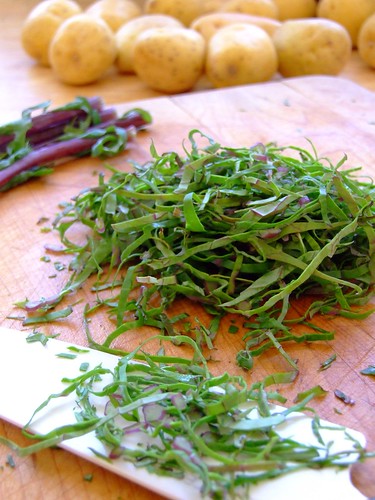
1 large bunch of kale, cut into as fine chiffonade as you can manage*
3 pounds small Yukon Gold potatoes, peeled and cut into 1-inch cubes
3 cloves garlic, minced
one handful scallions, sliced into thick rounds
8 ounces mild or spicy chouriço, sliced into thin rounds
2 tablespoons extra virgin olive oil
2 teaspoons kosher salt, plus more to taste (this will depend on the saltiness of your chouriço and broth)
64 ounces (8 cups) chicken broth

Toss the chouriço rounds into a large heavy pot (3+ quarts, preferably enamel) and turn burner heat to medium. Cook for 3-5 minutes, until they release a fair amount of their paprika-laced oil, but before they get really browned. Turn off the heat, remove the chouriço to a plate and pour off all but a tablespoon of the oil.

Return the burner heat to medium. Pour 2 tablespoons of olive oil into the pot with the chouriço oil and let it heat up for about 30 seconds. Add garlic and scallions and saute for 2 minutes, stirring often, until the garlic is slightly coloured. Do not let the garlic get too brown, or it will turn bitter. Add potatoes cubes and broth, and turn the heat to high. Cover and bring to a boil. As soon as it boils, turn the soup back to medium and cook, stirring occasionally, for 15-20 minutes, until the potatoes are tender. When the potatoes are done, use a potato masher (carefully, as the soup is still hot) to coarsely mash the potato cubes. This will give you a lovely thickened broth with a satisfying chunky texture. Add the kale ribbons and gently simmer the soup for another few minutes, until the kale has softened slightly.

I like to let it rest, covered and off the heat, for 15 minutes, to let the flavours soften and meld. Serve with thick slices of good, crusty bread.

* To chiffonade kale, break off the stems where they start to produce leaves. Pile 6-8 leaves on top of each other and roll them up lengthwise, tightly, like a cigar. Starting at the top of the roll, use a very sharp knife to cut the thinnest slices you can manage (if you're like me, you'll end up with some thick ones- this isok !). Continue slicing down the cigar until you reach the bottom end of the kale. You should have a pile of very thin kale ribbons.

Saturday, August 12, 2006

Angel-Hair Pasta with Fresh Tomato Sauce


(my very first food photograph!)


A few months ago, I bought subscriptions to Bon Appetit and Gourmet magazines as birthday gifts to myself. My goal: to justify further cluttering our already full bookshelves by making at least 5 recipes from each issue. Let's be honest here- I love reading through them again and again (and again... and again...), and there is no way I could force myself to throw old issues out. At least, not for a few decades.

When the July issue of Gourmet arrived, the cover recipe looked too good to pass up. I've made it a few times and, as always, I couldn't resist a bit of tweaking. After all, experimenting in the kitchen can be fun! And for those of us who are avid garlic lovers, the original recipe (which calls for one lonely little garlic clove) begs for a bigger garlicky kick. Here is our version:

Angel-Hair Pasta with Fresh Tomato Sauce
Makes 6 first-course servings or 3-4 main course servings.

2-3 large garlic cloves
3 lb mixed variety tomatoes (2 lbs mixed large tomatoes, 1 pound mixed cherry tomatoes)
1/4 cup pitted and chopped olives (Whole Foods sells scrumptious mixed, pitted olives)
2 tablespoons fresh lemon juice
1-2 tablespoons olive oil
1 teaspoon salt
1/2 teaspoon sugar
1/2 teaspoon black pepper
1 lb dried capellini (angel-hair pasta)
1/2 cup fresh basil, cut into chiffonade*

Mince garlic and mash to a paste with a pinch of salt using a large heavy knife. Core and coarsely chop two thirds of the large tomatoes. Slice small tomatoes in half. Halve remaining large tomatoes crosswise, then rub cut sides of tomatoes against large holes of a box grater or your largest microplane grater set in a large bowl, reserving pulp and discarding skin. Toss pulp with the chopped and sliced tomatoes, olives, garlic paste, lemon juice, olive oil, salt, sugar, pepper, and basil. Let stand until ready to use, at least 10 minutes (if you have time, let the tomato mixture stand at room temperature up to 2 hours). While tomatoes stand, cook pasta in a 6- to 8-quart pot of boiling salted water until al dente (2-3 minutes for fresh pasta, 4-6 minutes for dried pasta). Drain in a colander and immediately add to tomato mixture, tossing to combine. Pass parmesan cheese at the table for sprinkling, if you like.

The sauce goes well with pasta, of course, but if you want a tasty panzanella (Italian bread and tomato salad), you can omit the pasta and toss the sauce with 8-10 cups of cubed, day-old, crusty bread. For those who live in the Boston area, Pain D'Avignon (available at many Whole Foods locations) makes a delicious country bread that holds up beautifully to the wet sauce.

* To cut basil into chiffonade, pile 10-15 leaves on top of each other on a cutting board. Roll them up tightly lengthwise (like a cigar) then cut them on a diagonal into thin strips. I find that the sharper my knife, the thinner my basil strips.