Showing posts with label dessert. Show all posts

Wednesday, September 9, 2009

Christmas Cookies 2009. Already.


Yes. I am already thinking obsessing about this year's Christmas cookies.

The problem is that I like to make lots of different ones, and I haven't found too many recipes that I really love (and that warrant the time, energy, and expense of making tin after tin of sweets).

I will absolutely make my favourite gingerbread recipe, because to me, it's not a truly proper Christmas without it. Same goes for the pecan fingers/puckle warts, though those are a much newer addition to our must-have Christmas cookie list. My mom, in particular, looooooooves them, which is reason enough to keep them on the list.

I'm pretty sure that I will make molasses crinkles again, as they're easy and always a big hit. Part of me wonders if they're too much like the gingerbread, but then again, they satisfy my craving for cookies speckled with chewy, spicy pieces of crystallized ginger in a way that the gingerbread doesn't.

I've also fooled around with mint chocolate cookies and bitter cream & orange biscuits. Both were great, they didn't meet the last-more-than-a-few-days and ships-well requirements.

I could always choose from the slew of gorgeous, delicious Czech Christmas cookies my family makes... but honestly? I get huge boxes from two households every year, and they've been making them for ages, so how can my baking compare? I'd like to make something different for us and to give to friends and family.

Since the cookie recipes passed down in family all fall into the Czech (and already being made by others) category, my first inclination is to search epicurious.com for their highest-rated offerings. Italian fig cookies? Grasshopper squares? Salty-sweet langues de chat? Pâtes de fruits (aka. have I lost my mind)?

It's enough to make me crazy (or maybe it's just me making myself crazy?!). Funny how as the colder weather moves in, visions of sugarplums swirl in my head as I try to fall asleep.

Monday, September 7, 2009

My Mom's Alsatian Fruit Tart

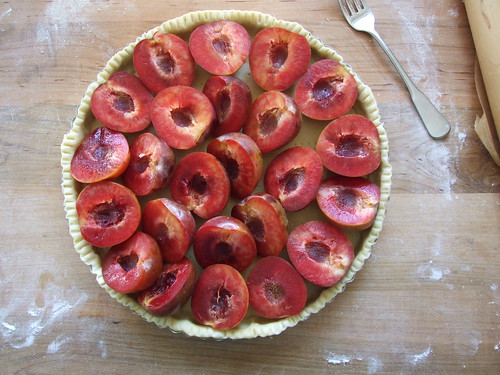
my mom's pluot tart, ready for half-baking (then we add the flan!)

My mom is an amazing cook, though she doesn't believe it when we tell her that.

My family is here (where my mom grew up) for three weeks. They're visiting other family and friends during the weeks, and coming back to us each weekend. Last night, we had a dinner for friends and family, and as I'd been drawn to some odd-looking, mottled pluots and bought a kilo on a whim (we used all but 4 of the pluots for this tart), I asked my mom to show me how she makes this tart. I have the recipe, but I hadn't watched her make it in a few years, and I like cooking with her better than following a recipe anyway.

It's super gorgeous and very easy. You make a buttery pâte brisée (no blind baking the shell) and line the tart pan with it. Then you put, cut side up, as many firm plum/pluot/apricot halves as will fit in the raw crust. Put this into a 400'F oven for 30 minutes or so. While it's baking, mix up the custard ingredients (this recipe would work nicely). Carefully pour this mixture into the hot, half-baked tart and bake until the custard is set and browned.

If your fruit is very juicy, skip the flan, sprinkle sugar on top of the fruit, and just bake it until the crust is golden, the juices are bubbling, and the sugar is a bit caramelized and crunchy.

We made this with elephant pluots, which were sort of dreary looking on the outside but turned out to have beautifully vivid, sweet-tart flesh. My mom makes this tart with all sorts of firm stone fruits (damson plums and apricots being her favourites), though the original recipe is for a tarte aux pommes alsacienne (Alsatian apple tart). The original recipe is from Elle Magazine en français, ca. 1970s, which she had a subscription to because she liked the recipe cards and knitting patterns, and because she liked to keep up her French reading skills. Not that she needs the help- she's a language whiz.

I was lucky enough to grow up thinking that everyone ate desserts like this.

Thursday, April 17, 2008

Strawberry Rhubarb Crumble


Ok. I know, I know. Rhubarb in April? That makes sense- it's just coming into season. But strawberries? In April? Not so much.

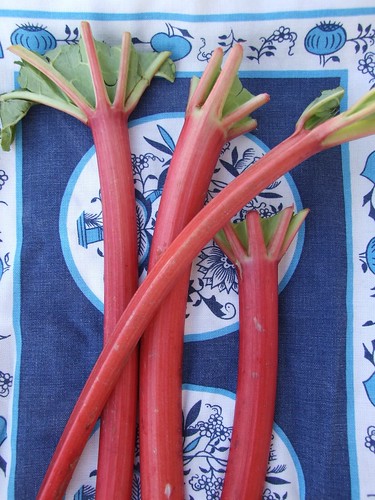
Here's the problem. Rhubarb is one of the first food plants to be ready to harvest in the Northeast, which means that rhubarb season has officially begun and the first young stalks- tender and flushed bright, coral pink- have finally appeared in my favourite grocery store.

Ok, that's not really the problem. The real issue is that, of course, the store had gorgeously bright stalks of rhubarb stacked strategically, temptingly close to pallets of strawberries. $8 for 8 pounds of berries is pretty damn cheap. But it's really not strawberry season here. Not even close- we have to wait for July for that. I don't think it's strawberry season on the West Coast either, so I am sure that these California strawberries were grown in a hothouse.

We were all set to resist them, thinking that we'd make do with just rhubarb. I was convinced that the strawberries would be, like so many hothouse grown fruits, all pretty looks with a bland, boring taste. But then, curiosity got the better of me and I leaned in to take a closer look at the ruby gems. That was when it hit me- the most fragrant summery scent I've enjoyed in months wafted up from the pallets.

Really, who can resist the idea of strawberry rhubarb crumble? Strawberry rhubarb sorbet? Strawberry rhubarb preserves? Strawberry rhubarb anything?

Not us. We came home with 8 pounds of tasty strawberries.

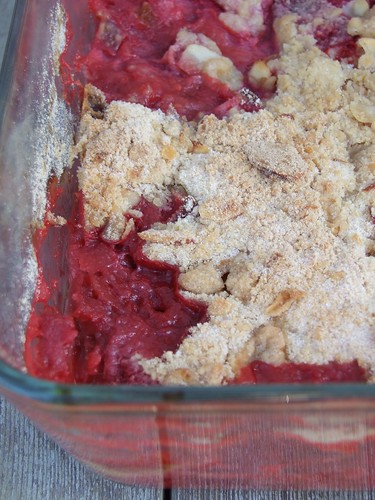
So, of course, the inaugural dish for the season's first rhubarb had to be a crumble. Perhaps we were blinded by the excitement of bright, summery flavours laced with a lovely refreshing note from the Cointreau- we happily devoured this plain, no ice cream needed... though I am sure a scoop or two wouldn't hurt!


Strawberry Rhubarb Crumble

For the filling:
2 quarts/16 ounces strawberries, washed and sliced into 1 inch pieces
8 ounces rhubarb, washed and sliced into 1/2-inch pieces
3/4 cup white sugar
1 teaspoon Cointreau (optional)

For the topping:
1 cups all-purpose flour
1/2 cup cold butter, cut into 1/2 inch dice
1/4 cup sliced almonds
3 tablespoons light brown sugar

Preheat oven to 400'F. Butter a 12 inch baking dish.

Toss rhubarb, strawberries, sugar and Cointreau (if using) in a bowl and set aside to macerate for 15-30 minutes.

To make the crumble topping, pour the flour and brown sugar into a small bowl. With quick movements and using the tips of your fingers, rub in the butter until it is thoroughly combined and has a texture like rough sand. Toss in the almonds.

Pour the fruit mixture into the buttered dish. Sprinkle the topping over the fruit.

Bake until topping is golden brown and fruit juices are bubbling, approximately 40-50 minutes. Serve warm.

Friday, March 14, 2008

Ina Garten's Double Chocolate Pudding


It seems that March is turning into Sweets Month around here! If we have a sunny day that makes photographing a bit easier, I'll extend the streak with a last call before the citrus season ends: the previously promised recipe for Italian Lemon Ice.

The cold, snowy and rainy weather (it's too early for rain!) we've been having here lately has made it difficult to take anything but dark, shadowy pictures. It's unfortunate, too, because this weather is best weathered (ha!) from the warm and cozy indoors, preferably with a mug of tea and a new recipe to try.

In this spirit of new recipes, I recently whipped up a batch of Ina Garten's Double Chocolate Pudding. Unlike custards, which can be fussy and have the potential to go very, very wrong, this recipe is wonderfully simple. Don't get me wrong- I love the delicious elegance of custards and pots de créme- but sometimes all you want is a recipe that doesn't require too much mental energy and concentration. This dark, intense chocolate pudding fits the bill perfectly.

Since I knew that pure chocolate flavour would be showcased here, I used Scharffen Berger cocoa powder and, since Ina calls for semisweet chocolate, Scharffen Berger's 62% chocolate.

Percentages, which you are probably seeing listed on chocolate more and more these days, refer to the percentage of cacao-derived ingredients in chocolate. Chocolate with a higher percentage listed has a substantial amount of cacao and less sugar, so it is often labelled bittersweet, bitter or unsweetened. Chocolate with a low %- like milk chocolate- contains less cacao and more flavourings like sugar, milk and vanilla. White chocolate contains only sugar, cocoa butter, and milk solids.


Making this pudding was, not surprisingly, a breeze. Everything went swimmingly until the end, when it took a while for the pudding to thicken over low heat. I was convinced that I'd done something wrong or left something out, and I kept re-reading the recipe while trying to whisk at the same time... but once it started to firm up, the pudding turned beautifully, custardy-thick very quickly. Phew! I know that I can always trust Ina's recipes. Don't know what was going on in my head there.

The ease of this recipe means that you have absolutely no reason not to try it, unless you don't like chocolate, in which case there is no hope for you. The pudding has a pleasingly smooth texture, fabulously rich cocoa flavour and a lovely, lingering bitter chocolate finish. It's definitely not airy in a mousse sort of way, but there is an incredible lightness to it all the same.

I'd absolutely serve it to guests in elegant little bowls, and I imagine it would make a lovely cake or pastry filling, though I believe it's most delicious when eaten straight out of the bowl, preferably with help from friends.

Friday, March 7, 2008

Maple Berry Frozen Yogurt


Lately I've been really, really tired- hence my one and only February post. Pathetic, I know. I do love my day job, but during the busy months, it's absolutely exhausting. Between a big conference and related week-long work trip to New York City, fighting off the colds and flus that travelled mercilessly around my office and every other workplace in Boston, multiple snowstorms and seemingly endless show shoveling, and turning 27 (a crazy fun day that also required full energy for hours of walking, museum and cooking supply shop visits, and of course, eating), February was a tough month.

I know things are bad when I don't even have the energy to cook- the one activity that usually relaxes and energizes me! The good news is that we're already halfway through the semester, which means just a few more months of hectic madness before my job settles back into a more normal, fluid routine and I have more energy for kitchen experiments at home!

When I'm stressed, my appetite goes out the window, so I knew things were getting back to normal when I felt the urge to try out the ice cream maker again- this time, to make something other than sorbet. We didn't have nearly enough whole milk or cream in the house (why do these urges to experiment come right after we've gone to the grocery store?!) for ice cream or gelato, but we did have quite a bit of one of my favourite foods: yogurt. I have a lifelong love affair going with dairy products, and yogurt is at the very top of that list. So of course, frozen yogurt it was!

The inspiration for this frozen yogurt comes from a lovely, simple dessert that L's mom serves often during the summer: plain yogurt sweetened with a touch of maple syrup and topped with fresh berries. In both fresh and frozen versions, the clean tang of the yogurt is balanced by the bright, fresh flavours of the berries and the distinctive woodsy sweetness of the maple syrup. Salt sounds like a strange addition, but it really does bring out vibrant notes in sweets (see chocolates and caramels sprinkled with fleur de sel).

I used my favourite store-bought yogurt: Liberté 2%, and a frozen mixture of strawberries, blackberries, raspberries and blueberries. A gorgeous plummy purple flecked with vivid specks of juicy berries, easy-peasy recipe and healthier than ice cream- how can you go wrong?


Maple Berry Frozen Yogurt
makes approximately 5 cups

27 ounces/3 1/3 cups plain yogurt, thoroughly chilled
3/4 cups Grade A maple syrup, thoroughly chilled
10 ounces mixed berries, chilled if fresh or slightly thawed if frozen
pinch of salt

2+ quart capacity bowl, chilled in the refrigerator

Coarsely mash by hand the cold berries and any juice they give off, or roughly purée with just a few pulses in a food processor.

Quickly mix cold yogurt, maple syrup, berries and salt together in a cold bowl. Freeze according to your ice cream maker instructions (this batch took 30 minutes in my Cuisinart 2 quart ice cream maker).

Pack into containers and store in the freezer- the yogurt will harden considerably in the next 24 hours.

Sunday, March 2, 2008

Maslenitsa and Simple Blini


Ма́сленица, Maslenitsa, or "Butter Week," the Russian equivalent of Carnival or Shrovetide, is celebrated during the week leading up to orthodox Lent (March 2-8 this year). The holiday is full of merriment: Punch and Judy-style puppets shows, theatrical performances, troika sled rides, singing, bonfires, fireworks, a burning kostroma effigy to bid winter farewell and fertilize the coming crops... and nutty fun like icy-pole-climbing contests, naked "polar bear" dips in frozen rivers and lakes, and fistfights.

While I grew up celebrating Fat Tuesday, for some reason I've always preferred the blini and vodka-laden festival that is Maslenitsa.

Blini, an essential part of Maslenitsa, can be likened to Russian pancakes. They come in thin, delicate un-yeasted (like French crêpes) and thick, fluffy yeasted versions, and are always, always, always eaten in copious quantities with a variety of sweet and savoury fillings.

During his six-week high school homestay in Moscow, L was told by his host family that a real man will eat two forearm-length-tall stacks of blini, but that as an American, he would be allowed to get by on a one-forearm-length stack. Three years later, when I was a student in Moscow and L flew over from Egypt to visit, we were invited to an amazing, sumptuous dinner at the family's home, where true to her word, his former host mother cooked up the only appropriate amount for her family and the two of us: eye-high stacks of fabulously delicious blini.

A year later, my friend C and I were two of the four Russian majors in our class, and we lived in the same on-campus house that senior year of college. So naturally, we offered to host the Russian Department's yearly Maslenitsa festivities at our place. Early that morning, we rose and prepared the yeast blini batter, and I mixed up a huge batch of un-yeasted blini as well, for good measure. Early afternoon, when the guests started to arrive, arms piled high with bottles of vodka and homemade blini fillings, the fun officially began.

Out came both enormous bowls of batters. I showed our other housemates, who had happily joined in the merriment, and a few cooking-inclined Russian Studies students, how to pan-fry blini, and everyone took turns pouring batter, flipping the golden blini higher and higher, and sliding piping hot ones quickly onto plates ready for refills.

Over the course of a few hours, we made hundreds of blini for guests to pile high with the incredible array of homemade fillings: savoury sautéed wild mushrooms, ever-present and addictively-tasty marinated mushrooms, delicious баклажанная икра (bakhlazhanaya ikra, or eggplant caviar), salty home-smoked fish, thick sour cream, creamy fresh tvorog, glittering kompot, syrupy jams, sticky dark honey, rich local butter, and much more.

As bellies filled and blini consumption slowed, shots of icy-cold vodka flowed and "za druzhba! to friendship!" toasts carried through the house to the snow-covered front porch. As winter twilight descended and night fell, all around cheeks glowed pink from the blini-cooking stovetop warmth and free-flowing vodka. We celebrated for hours, and a faint, rosy morning light shone as the last guests departed, singing and laughing at the tops of their lungs.

Thankfully, most of our guests were students who lived on campus, and they left in pairs and groups to walk safely home; those who weren't students left with two designated drivers. No walking alone or driving for anyone that night!

I don't think I will be outdoing that celebration for at least a few more years! In the meantime, however, we will celebrate Maslenitsa with my favourite blini- a light, unyeasted recipe that turns out very thin pancakes with curled, crisp, lacy edges. There is some argument as to whether or not these can be called blini at all, as some people say that unyeasted pancakes are entirely different and must be called blintzes, but my Russian friends assure me that I can call them blini without reproach.

These blini are identical to many recipes for Czech palačinky- one of my childhood and current comfort foods- which is probably why I like them best. While it's not the traditional thick and fluffy version, this recipe is absolutely respectable for Maslenitsa celebrations.

This recipe lends itself well to doubling, tripling, and beyond. Don't worry if the first blin comes out looking awful, as this is just the way blini cooking works. The Russians even have a phrase for it: pervyni blin komom (the first blin is a flop)!


Simple Blini (or Palačinky)

1 cup all-purpose or whole wheat flour
1 1/3 cups milk (not skim)
1 egg
pinch of salt
1 teaspoon sugar (optional- only for sweet fillings)
Butter for pan

If possible, turn oven to very low heat and put a stack of plates inside to warm up. Alternately, you can use Alton Brown's method and warm the plates under an electrical heating pad. Cold plates will cool the blini very quickly, and they are best when piping hot.

In a large bowl, whisk together flour and salt to combine. In a separate bowl, beat the egg, then add milk (and sugar, if using) and whisk until well-mixed. Add egg and milk mixture to flour mixture and beat until smooth. You should have a fairly thin batter with few lumps.

Heat a heavy medium-sized griddle (a crêpe pan works well) on medium heat for two minutes. Add a pat of butter to the pan- if butter immediately smokes, pour off butter and turn the heat down. You want the butter to sizzle without burning.

Add 1/2 or 1/4 cup batter* to the pan and quickly swirl the pan at an angle so that the batter runs out in from the center all directions. Cook for 30 seconds and then start checking the underside- when it is golden brown, quickly flip the blin and cook for 15-30 seconds more, until golden spots appear on the pale underside and the blin moves freely on the pan.

Slide the blin onto a warm plate, top with a thin layer of filling(s), roll or fold up, and serve immediately.

* Makes 6 medium (1/2 cup batter) or 12 small (1/4 cup batter) blini.

Saturday, January 12, 2008

Blood Orange Sorbet


Now that the Christmas and New Year holiday celebrations are over and life is a bit less hectic, I've had time to try out the gorgeous ice cream maker that L gave me for Christmas! I've coveted one for a quite a while, and am absolutely thrilled with this one. For a machine with such a simple mechanism it works beautifully, and we've had great success with it so far. L certainly knows that fun kitchen gadgets are the way to my heart!

As citrus season is upon us and there are so many tasty fruits just waiting to be eaten, I've been experimenting entirely with fruit sorbets. The very first thing I made was a positively addictive, intensely refreshing Italian Lemon Ice (post on that coming soon) from The Gourmet Cookbook that, for some reason, doesn't seem to be in their online recipe database. I was worried that it would be too sweet, but during our many taste tests I realised that I should have a bit more faith in Gourmet's recipes- the Lemon Ice was tart and sweet, with a fabulous icy mouth-feel and lovely hint of bitterness from the zest. We immediately made three more batches to share with family and friends at holiday dinners.

Aside from blueberries, I think blood oranges have got to be my favourite fruits, so naturally, I've been itching to make a blood orange sorbet. If you have an electric juicer and/or microplane zesting rasp, now is the time to use both. The lovely thing about sorbet is that when you base your recipes on flavours combinations you love, you really can't go terribly wrong when experimenting. Happily, we were thrilled with my first pass at blood orange sorbet- the texture is very smooth, and the intense blood orange flavour comes right through, with just the right balance of honeyed sweetness and bright citrus tang. I love the vibrant rosy colour, too!

So many sorbet recipes call for water to make the simple syrup, but I like a more intense flavour and colour, so I prefer to use only juice. I also adore the flavour of honey paired with fruits, so for citrus sorbets, I try to use honey in place of granulated sugar whenever possible. According to David Lebovitz (The Perfect Scoop), honey gives frozen desserts a smoother texture, too, due to the higher concentration of sugars.

If you made New Years resolutions to get healthier, exercise more, or at least try to eat better, then this is the perfect dessert for you. If you didn't bother with those kinds of resolutions, you can eat even more sorbet in one sitting!


Blood Orange Sorbet

3 cups (24 ounces/710 ml) freshly squeezed blood orange juice
3/4 cup (6 ounces/177 ml) cup good honey or 1 cup (8 ounces/227 g) white granulated sugar
2 tablespoons (28 grams) finely grated blood orange zest
2 tablespoons blood orange pulp (optional)
pinch of salt

Make a simple syrup by warming 1 cup of blood orange juice with honey or sugar over low heat, stirring frequently, until the honey or sugar has completely dissolved.

Remove from heat and stir in zest and salt. Stir in blood orange pulp, if using.

Pour simple syrup into a bowl with the remaining 2 cups blood orange juice and stir to combine.

Chill mixture thoroughly, then freeze according to your ice cream maker instructions. Initially, the sorbet will seem fairly soft, but it will firm up considerably in the freezer.

If you don't have an ice cream maker, don't worry- you can turn this into a granita! Pour the chilled mixture into a shallow pan and freeze, stirring with a fork every 30 minutes, until slushy- about 2 hours.

Sunday, December 16, 2007

Christmas Cookies: New England Molasses Gingerbread Cookies


I absolutely despise molasses (no shoofly pie for me, thanks), but for some reason, when the strong molasses flavour is tempered by aromatic spices and the gentle heat of ginger, as it is in gingerbread, I'm in heaven.


I think this has quite a lot to do with my paternal grandmother. When I was a child, my Bohemian babička, or Czech grandmother, and her Czech friends would get together in their Chicago kitchens during the holiday season, and together they would bake and decorate amazingly delectable, incredibly gorgeous perniky, or Czech gingerbread cookies. The icing was always pure, snowy white, and if I was lucky, I'd find tiny silver nonpareils sprinkled strategically over the lines and swirls of icing.


At the end of November, the perniky would arrive at our house, carefully packed between layers of pristine white tissue paper, in a wide, flat, white pâtisserie pastry box beautifully tied up with twine. For some reason, my grandmother used only twine- never, ever scotch tape- when she wrapped gifts. I've never got the hang of that particular skill.

Once I knew the cookies had arrived, I'd beg and plead with my mother, but to no avail- I was allowed only one cookie each day leading up to Christmas Eve- the day Czechs celebrate Christmas. At the time, I thought it supremely unreasonable, but now that I've learned how much work really goes into decorated cookies, I understand her thinking. Treats this time-consuming to make should be savoured slowly and appreciatively, even by greedy five-year-olds!


For some stupid reason, I never thought to ask for the perniky recipe while my grandmother was alive- perhaps they do taste better when made with mysterious ingredients by a grandma- and I've been looking for a comparable recipe ever since she passed away. Even more frustrating is the fact that I have a book of her recipes that was discovered by my father and given to me last Christmas, but so far I haven't been able to find her gingerbread cookies amid the pages and pages of recipes written in her tiny, perfectly elegant script.


Luckily, while browsing online collections of Christmas cookie recipes in November, I came across
Bon Appétit's recipe for New England Molasses Gingerbread Cookies and saw that a few reviewers likened them to traditional German Pfeffernüsse and Lebkuchen. I knew at once that this recipe would be a good place to start.


The dough was soft and a bit tricky to work with, but it was also fairly forgiving and much easier to handle when I worked in small amounts, leaving the rest to chill in the 'fridge. I used regular (not robust or blackstrap) molasses, doubled the spices, and added a few good shakes (probably about a teaspoon each) of allspice and nutmeg to the mix. I also used Dorie Greenspan's Royal Icing recipe, which immediately became my new favourite- the icing was incredibly easy to pipe smoothly, stayed pliable in the pastry bag for at least a few hours, and hardened to a gorgeously snowy white, durable, faintly citrus finish with just the right amount of sweetness.


I used a few favourite cookie cutter shapes, including the traditional lucky Czech zlaté prasátko (golden Christmas pig) in two different sizes: medium-sized 2-3 inch and tiny 1-inch diameter. Decorating them took a long time, but once you get into a rhythm, everything goes quickly and smoothly (though I did have to take breaks to stretch out my arms and hands). Having a glass of wine on hand definitely helps, too.


The day I baked them, the gingerbread cookies were crisp and tasty, with a lovely blend of spices that intensified after the first bite. I was happy with them, but admitted to myself that something was missing- they weren't quite what I remembered. As most gingerbread needs a bit of time to improve, however, I hoped that these might as well, and I was not disappointed. A few days later, they had softened considerably to a more cake-like crumb, the spices noticeably more intense and complex- a flavour, when mingled with the sweet crunch of the icing, very, very much like my grandmother's perniky. I have rediscovered my childhood addiction, and in case you can't tell, these are the Christmas cookies of which I am most proud!


I've since found Czech gingerbread recipes online that include rum, coffee, honey, and ground spices like mace, star anise, aniseed, black pepper and coriander. I'm tempted to give other combinations a try, but am thrilled that I have a solid recipe to rely on each year! I suspect they'll never be quite as perfect as they are in my memories, but isn't that always the case?

Thursday, December 13, 2007

Christmas Cookies: Pecan Fingers


Christmas is that time of year when we, like so many other people, pull out all the stops when it comes to sweets. Into cookies and cakes go dark, rich Valrhona and Ghirardelli chocolate bars and cocoa powder, fragrant roasted nuts, shiny glaceed fruits, sticky sweet dates and dried figs, glittering candied citrus peel, spicy crystallized ginger, syrupy-thick molasses, local wildflower honey, Madagascar Bourbon vanilla, vibrantly yellow farm eggs (so tasty that we won't buy anything else), creamy, rich bars of European-style butter, butter and more butter...

In spite of my adoration for all these luscious ingredients, we don't often eat desserts at home, save the few times throughout the year when I get the urge to bake. I certainly can bake reasonably well (i.e. I can follow instructions of well-written recipes), but I have to be in a baking mood to really enjoy it.

Our friend Ida, on the other hand, is absolutely, positively, without a doubt a baking queen. She's an amazing, intuitive baker, and I am in love with her strawberry cheesecake (best made, it turns out, with a cocktail in hand) and carrot cake with cream cheese frosting. When we're lucky, she sends us home with sweets, but alas, it's always too dark to get decent pictures, and the yummy goodness is always gone in a flash anyway.


In any case, I do get the urge to bake like mad during the Christmas season. Spicy, citrusy, chocolaty- whatever the flavour, intense sweet aromas waft through the warm house. There is something so comforting about a warm kitchen full of tempting scents. Happily, I still have the energy for some intense cookie baking, so last night, I tested my fourth Christmas cookie recipe: Pecan Fingers or Puckle Warts.

When I was forming the pecan fingers, I couldn't help but notice that they looked more like shiny, pecan-studded baby... well, I won't say it. It's a bit gross, albeit somewhat amusing. I guess I'm not that good at forming cookies into appetizing log shapes. Is that even possible? Anyone?

With all that butter, too, I wondered how the cookies would hold up to being rolled between warm hands and baked in the oven for such a long time. Is one inch of space between the cookies really enough? Would they spread out too much? I'm glad to report that they came out exactly as described in the recipe, partially due, I am sure, to the long chilling time (I chilled them overnight out of necessity) and low, low baking heat.

The Pecan Fingers turned out to be absolutely, wonderfully addictive- oh my goodness, they are that good- with a light, shortbread-like buttery texture, fabulous honey undercurrent, nutty crunch that complements the crisp dough quite nicely, and a lingering sweetness from the double dustings of light, powdery confectioner's sugar. The dough is very easy to mix up, too- especially so if you have any kind of electric mixer.

The flame-coloured Le Creuset terrine mold my mom gave me a few years ago (I got lucky here- she was given two at her 1972 wedding to my father!), lined with a bit of waxed paper and clingfilm, is a perfectly-sized storage container for a few cookies short of one full batch- a convenient excuse for some taste testing, no?

I'm thrilled with another very successful recipe, and am very glad that, once again, Epicurious reviewers came through with reliable ratings and advice!

Monday, December 10, 2007

Christmas Cookies: Mint Chocolate Cookies


As you may have noticed, I often rely on recipes. Sometimes I tweak them until I feel like they've really become quite a bit more mine, if that makes sense, with grateful thanks to the person who provided the original recipe and a solid a jumping-off point. Other times, I end up adoring recipes as they are, perhaps with a few minor changes or additions, and I just want to tell everyone about this great! new! recipe! that I've found.

Not very original in the end, perhaps, but I'm finding that this blog has turned into a great way to share recipes with friends, as well as document my own experiments and newly discovered favourites for myself, too.

On that note, I discovered a few great Christmas cookie recipes this weekend. I printed out a pile of choices earlier in the week, and on Saturday morning L and I narrowed down the list to six recipes we wanted to try the most and headed out to buy extra whole wheat flour (it's always King Arthur flour in this house), molasses, confectioner's sugar and peppermint extract.


First, I made another batch of the Molasses Crinkles, since the first batch has been flying out of the cookie tin; then, I mixed up a batch of Mint Chocolate Cookies from the December 2000 volume of Bon Appétit.

The Mint Chocolate Cookies are soft and rich, and the light cocoa crumb and fabulous, clear peppermint note are reminiscent of Girl Scout cookie Thin Mints. I increased the peppermint extract to 3 teaspoons (1 tablespoon) and drizzled the cooled cookies with melted bittersweet chocolate, which took about 2 hours to cool and harden. They were a bit crumbly the day I baked them, but since then they have taken on a bit more brownie-like moisture. Some reviewers recommend cutting out 1/2 cup of the flour, and while the cookies are fabulous as is, I might give that a try with the next batch to see if they get even better!

Monday, December 3, 2007

Christmas Cookies: Molasses Crinkles


For as long as I can remember, I've had a close fondness for the Czech Christmas cookies I grew up eating from the beginning of December through New Years Eve and into January. I'm sure it's partially due to the fabulous cookies themselves, and part warm and fuzzy attachment to familiar, comforting traditions.

Every year at the end of November, heavy balls of both pale and dark doughs, wrapped tightly in waxed paper, pile up in the fridge; during weekends, the sweet smells of beautiful, delicious, and always tiny cookies and confections waft through the house.

There are always many different flavours and cookie types to savour, though the yearly lineup, specific to each family and passed down through generations of Czech women, generally remains the same in each household. Of course, I've always particularly loved the sweets that appear on my family's cookie platters: confections like crumbly, cocoa-brown Bear Paws dotted with crunchy walnuts, moist Almond Baskets brimming with sticky, nutty filling, sugary Beehives piped full of fluffy pastry cream, potent rum-spiked Chocolate Balls, thin Fig Salami slices peppered with dried figs and glaceed fruits, and my absolute favourites: Linecke Kolačky, which are very much like Linzer cookies, filled with a thin, sparkling layer of raspberry jam and glistening with a shiny, egg-washed surface.

To me, Christmas is not the same without those Czech cookies. But, in the interest of expanding my own repertoire, I am always looking for outstanding additions to the usual lineup. This year, I turned to one of my favourite sources: Epicurious. I am always drawn to the collections of cookie recipes that Gourmet and Bon Appétit magazines publish each winter, even though I know, in reality, that I will never find time to test all of the recipes I drool over each November.


I do, however, manage to narrow down my long, unmanageable dream list and try a few recipes, and last night I made my first test batch of Christmas cookies: Molasses Crinkles from the December 2004 volume of Gourmet. Because I, like my mom, absolutely love ginger in all forms, I took the advice of a few reviewers: I doubled the amount of ground ginger and added 1/2 cup of chopped crystallized ginger to the dough. I also baked the cookies for 9 minutes total- at 10 minutes, the cookies wavered between chewy and very crisp, depending on how soon I was able to get to the oven after the timer beeped.

Just as I'd hoped, these treats completely satisfy my ginger cookie cravings, and L and I were both really happy with how well the recipe turned out on the first try. I'll be surprised if this batch lasts more than a week! The cookies have a chewy center and crisp edges- the effect you typically get when you add butter and vegetable shortening to cookie dough- a great spiced ginger heat, and a delicious crackly sugar surface (L loves a crunchy sprinkling of sugar on baked goods, so I knew this aspect would really appeal to him). Molasses Crinkles are definitely going in my permanent Christmas recipe collection!

Tuesday, October 16, 2007

Banana Bread


Something about autumn makes me want to bake and bake, and then bake a bit more, as though we didn't have enough baked treats around already. During the hot summer months, it's hard to justify heating up the entire house for a loaf of bread or a cake that you're too hot to really want in the first place. During the fall, however, I adore the warmth radiating from the stovetop and the tantalizing baking aromas that waft through the house.

My post last week on spiced pumpkin bread got me thinking about, and of course craving, my mom's banana bread. I absolutely love it, but for some reason I've never gotten around to asking her for the recipe. We had a bunch of very, very ripe bananas on our counter for the past few days, which meant that there was only one thing to do! One weekend night at around midnight, when it was way too late to call and beg for the recipe, I realised that tweaking the pumpkin bread recipe might just do the trick.


Instead of pumpkin, I used four medium-sized, very ripe mashed bananas, along with 1/2 cup of roasted, mashed acorn squash that I found languishing in the 'fridge. This particular squash had such a subtle taste that I hoped it would add substance and texture without overpowering the banana flavour. I also omitted the heaping teaspoons of spices, opting instead for 1 teaspoon of allspice and 1 teaspoon of vanilla extract. And, as I usually do, I omitted the walnuts.

The bread came out golden and moist, with a pronounced, pleasant banana flavour. It tasted almost exactly like my mom's version. The recipe makes two large loaves, so once it had cooled, one loaf went right into the freezer. It will probably be eaten next week for weekday breakfasts.

Of course, there's nothing quite like a recipe that you grew up adoring, but I'm thrilled that this is pretty darn close!

Monday, October 8, 2007

Spiced Pumpkin Bread + Roasted Squash


I'm not a big fan of nutty, dry, light banana/zucchini/pumpkin-and-nut breads, but I do love their dark, moist, dense counterparts. I'm sure that this preference can be traced directly to my mom, who makes a flavourful, impossibly moist banana bread that I absolutely adore.

Last fall, during one of my frequent, late-night sudden urges to bake, I stumbled upon a Bon Appetit recipe for spiced pumpkin bread. I was in love at first bite, when I realised that this is the perfect fall version of my mom's banana bread.

Just a few notes from personal experience:

* I cut the sugar down to 2 cups, and I use 1 cup white, 1 cup brown sugar.

* To make up for the lost sugar, I add one extra egg; in the baking world, sugar is considered a liquid, so the egg is a successful substitution here.

* I omit the walnuts, as I prefer this bread sans nuts.

* I add a teaspoon of ground ginger for a hint of spicy heat.

* While I love the flavour of pumpkin, I've found that this recipe works really well with other roasted squash, too.

I highly recommend roasting your own pumpkin or squash for this bread. It's not difficult at all, and it tastes so much better than anything you can buy in a can.

You can also eat this squash- cubed or mashed- alongside a chicken or other roasted meats. Either way, you might just find yourself buying more Halloween pumpkins just for the leftovers!

This is the easiest way, that I know of, to both cook hard winter squash and remove the skin.


Roasted Squash

any amount winter squash*, stem ends sliced off, cut into manageable pieces**, seeds scooped out, skin left on

small amount olive oil or neutral vegetable oil


Preheat oven to 425'F. Cover baking sheets with parchment paper.

Set squash pieces, skin side down, onto the parchment paper. Brush cut sides with oil. Roast in the middle of your oven until a fork easily pierces the flesh (start checking at 30 minutes). Remove from oven and allow to cool.

When the squash is cool enough to handle, peel off the skin and cut into chunks, or process using a food mill.

* Butternut, acorn, delicata, spaghetti, pumpkin, etc.
** Cut large squash (over 1 lb) into quarters or eighths, lengthwise; smaller squash (less than 1 lb) can be cut into halves, lengthwise

Thursday, October 4, 2007

Apples + Spiced Plum Applesauce


As part of our yearly CSA membership, we purchase a fruit share that comes directly from a local partner farm. This amounts to a 1/2 peck of fruit every week- mostly apples, sometimes plums, peaches and pears, and occasionally a bunch or two of concord grapes.

Apples are unfailingly abundant in the fruit share, and we can always count on seeing a different mix of cultivars each week. Some are familiar, others are entirely unknown, and it's fun to sample the strikingly different flavours and textures.

Our favourite is the Macoun apple, a good eating and cooking apple, and a cross between the Arkansas black and McIntosh cultivars. Macouns are usually small and flushed vivid pink or red, with icy-white, sweet-tart juicy flesh. Sadly, they only comes into season for a few short weeks somewhere between September and November, which for us means a flurry of apple dishes and at least 2 apples eaten out-of-hand each day until, in a flash, they're out of season until next autumn.

This week, we brought home a bag of Macouns, Cox's Orange Pippins and Gala apples. We ate as many as we could, and I turned the rest into my favourite breakfast, dessert and snack: applesauce!


You can make this applesauce with one type or a mixed variety of apples, and you can leave small strips of peel on the apples if you like an extra bit of texture. If you use a food mill to process the finished applesauce, you can skip the peeling step altogether- when you run the applesauce through the mill, any of the smaller plates will force the flesh through, leaving most of the skins behind.

If you want applesauce straight up, omit the plums; if you want something a bit different, substitute 1 pint of berries for the plums. I love this mixed with an equal amount of roasted, mashed butternut squash or pumpkin.

Spiced Plum Applesauce
Makes about 6 cups

3 pounds apples, peeled, cored and cut into large chunks
1 pint damson plums, pitted
2 cups water
1/3 cup light brown sugar, plus more to taste
juice of 1 lemon
1-inch piece of fresh ginger, peeled (optional)
1 cinnamon stick
1 star anise pod
1 cardamom pod
dash of nutmeg

Put all ingredients except the lemon juice into a nonreactive* saucepan. Turn burner to low heat and cook at a steady simmer, covered and stirring occasionally. When the apples are soft- after about 45 minutes- turn off the heat and stir in the lemon juice.

Remove from heat and allow to cool. When the applesauce has cooled to room temperature, remove the ginger, cinnamon stick, star anise and cardamom pod. Taste and correct for sugar.

At this point, you have multiple mashing options:

Use a potato masher or fork for a chunky texture
Use a food mill fitted with the largest-holed disc for a medium texture
Use a food mill fitted with a small-holed disc for a fine texture
Use a food processor for a fine texture- go easy and pulse sparingly here
Divide the applesauce and use more than one method for a mix of textures

*nonreactive = enamel or stainless steel; not aluminum or cast-iron

Tuesday, August 7, 2007

Ina Garten's Summer Fruit Crostata


Tonight, all of a sudden and without warning, I had the irresistible urge to bake. I'm not one of those people who loves to bake all kinds of adventurous treats in my spare time. I can bake certain things, but if I'm putzing around in the kitchen, I usually prefer to be cooking.

We had a huge platter of quickly-ripening peaches in the dining room (I read that you're supposed to ripen them stem-side-down in a cool room, and our kitchen isn't air conditioned), and I really wanted to bake something I'd never made before. In a flash of inspiration, I remembered seeing a crostata recipe in Ina Garten's Barefoot Contessa at Home cookbook. Crostatas sound so tempting in a romantic, rustic sort of way (just what the cookbook editors want, I am sure), so I decided to give the recipe a try.

So, now I have a confession to make. I have an irrational fear of dough, crusts, and anything else that requires that sort of baking precision. I've had tart shells turn out beautifully (by accident), and I've had them fail miserably (more often than not). I haven't yet got a technique down, nor do I have a favourite, perfect, never-fails recipe. My mother has both, and she sets a high standard- I grew up eating her beautiful, flaky, tender tart shells. I would love to be able to make them, too.

It's now 8 pm, I've made the dough, and it's been resting in the fridge for exactly an hour. I'm an impatient baker, so I'm off to roll it out, fill it, and pop it in the oven.

The good news is that L is napping, so if the crostata dough comes out truly awful, I can rescue the fruit, share it with the dog, and L will never know. Bonus: after that, the dog will definitely love me more than he loves L.

Wish me luck!
........................


Oh, frabjous day! The crostata is beautiful! Beautifully messy, that is, and very tasty.

The filling was piled dangerously high, but it cooked down to a manageable amount. The crust is wonderfully flaky, though I'm afraid I was overzealous and I rolled it out a bit more than I meant to. It doesn't seem to have suffered much, so hopefully this really is one of those perfect, consistently-good dough recipes that I keep hearing about.

I'm not going to reproduce the recipe here, because I think that counts as copyright infringement or something equally bad. I can, however, tell you that it's very similar to Ina Garten's apple crostata recipe. Instead of the apple and spice filling, I used 1 1/2 pounds of unpeeled, sliced peaches and 1/2 pint blueberries. As directed in the cookbook (summer fruit) version, I tossed the sliced fruit in 1 tablespoon sugar, 2 tablespoons orange juice, and the orange zest also called for in the apple crostata recipe. I then used the fruit mixture as you would the spiced apple filling.

It was a hard sacrifice as far as blueberries are concerned, since I have an awful tendency to hoard them all for myself, but it was definitely worth it! We have some strawberries in the fridge, and the dough recipe makes enough for two crostatas; I suspect I'll get the itch to make another fruit crostata before the week is out! All in the name of valuable and important baking practise, of course...

Wednesday, July 4, 2007

National Ice Cream Month


sticky toffee pudding ice cream

Since 1984, the US has celebrated National Ice Cream Month each July and National Ice Cream Day on the third Sunday of the month (July 15, 2007).

It seems that everyone around here goes a little crazy for ice cream during the summer months. Epicurious named their top ten favourite ice cream parlours in the US; I was happy to see that Toscanini's, a well-known Cambridge institution among ice cream lovers, made the cut for their fabulous flavours like Grape Nuts, cake batter, prune and armagnac, cardamom, and burnt caramel. In fact, the New York Times has named Toscanini's ice cream "the best ice cream in the world." If you can't get to a cone or pint of Toscanini's, see if a shop near you made the Epicurious list!

If you, like me, are interested in random culinary facts, you might like to know that, according to the International Dairy Foods Association, the most popular ice cream flavours in the US are: vanilla, chocolate, neapolitan, strawberry, and cookies and cream. I don't have an absolute 100% favourite flavour, but if I had to choose, I might pick the sweet cream ice cream that L's parents magically procure each summer from a small ice cream shop in Maine. It's delicious, and I have no idea where they get it. I wonder if it isn't better that way?!


our ice cream scoop (c. 1930 and still going strong!)

When then-President Ronald Reagan proclaimed the US ice cream holidays in 1984, he asked people to "observe these events with appropriate ceremonies and activities." Another excuse to eat ice cream? I can do that!

If ice cream is not your thing (but how could you?!), July is also National Baked Bean Month*, National Hot Dog Month, and perhaps my favourite, National July Belongs to Blueberries Month. Can you find a better excuse to eat up?

*
I'd like to know why something like baked beans, which in my mind means long heat-up-your-kitchen cooking, has been relegated to July. Why?!

Sunday, June 17, 2007

Maine Honey + Peaches


During the Presidents' Day holiday weekend back in February, we were invited up to A's family's farm in Maine. Five of us spent the weekend learning (or in A's case, teaching) to snowboard and feasting on incredible homegrown food. After three days of sausages and bacon from their own pigs, eggs collected each morning, fresh milk and cream from the cow in the barn, and bagels straight out of the oven with last summer's raspberry-rhubarb jam (and much, much more), I'm surprised that any of us could walk!

The morning we departed we were treated to an incredible cheesecake with glazed strawberries (all homemade, and a fabulous surprise as it was my birthday!), and we were each sent home, as if they hadn't been generous enough already, with a huge jar of exquisite honey from the beehives in their apple orchard.

So far, we have been fairly conservative with our jar of Maine honey. I want it to last as long as possible (honey keeps beautifully), and we can get good local honey from my favourite produce store, so I use that when I need more than a few spoonfuls. As A and S are visiting for the weekend, though, I thought it would only be fitting that we bring out the special stuff.

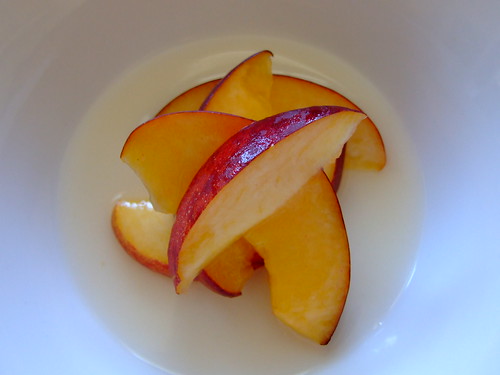
We're starting to see baskets of surprisingly tasty tree-ripened peaches around here, so this morning I sliced four large ones into thin wedges and drizzled 1/4 cup of honey over the slices. After letting the concoction macerate for 15 minutes, we had peach slices in a refreshing peachy-honey syrup.


The honey has crystallized in the jar and is perfectly good as is, but for this I wanted a smooth syrup. I was able to return the grainy honey to its liquid state using a trick I garnered from an old cookbook- by spooning a few lumps into a pyrex cup and letting the cup sit in a bowl of warm water for a few minutes.


Note: Do note feed honey to children under 1 year of age.